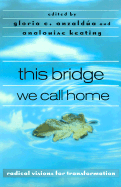
More than twenty years after the ground-breaking anthology This Bridge Called My Back called upon feminists to envision new forms of communities and practices, Gloria E. Anzaldúa and AnaLouise Keating have painstakingly assembled a new collection of over eighty original writings that offers a bold new vision of women-of-color consciousness for the twenty-first century. Written by women and men--both "of color" and "white"-- this bridge we call home will challenge readers to rethink existing categories and invent new individual and collective identities.
Part 1 ?Looking for my own bridge to get over? ? exploring the impact; Chapter 1 Open the Door, Nora Gutierrez; Chapter 2 Chameleon, Lobel Andemicael; Chapter 3 Del puente al arco iris: transformando de guerrera a mujer de la paz?From Bridge to Rainbow: Transforming from Warrior to Woman of Peace, Renée M. Martínez; Chapter 4 Nacido en un Puente/Born on a Bridge, Hector Carbajal; Chapter 5 Engaging Contradictions, Creating Home ?Three Letters, Alicia P. Rodriguez, Susana L. Vasquez; Chapter 6 Bridges/Backs/Books: A Love Letter to the Editors, Jesse Swan; Chapter 7 Bridging Different Views: Australian and Asia-Pacific Engagements with This Bridge Called My Back, Helen Johnson; Chapter 8 Thinking Again: This Bridge Called My Back and the Challenge to Whiteness, Rebecca Aanerud; Chapter 9 The Spirit of This Bridge, Donna Hightower Langston; Chapter 10 Remembering This Bridge, Remembering Ourselves: Yearning, Memory, and Desire, M. Jacqui Alexander; Chapter 11 Seventh Fire, Joanne DiNova; Part 2 ?Still struggling with the boxes people try to put me in? ? resisting the labels; Chapter 12 Interracial, Amy Sara Carroll; Chapter 13 Los Intersticios: Recasting Moving Selves, Evelyn Alsultany; Chapter 14 Gallina Ciega: Turning the Game on Itself, Leticia Hernández-Linares; Chapter 15 Que Onda Mother Goose: The Real Nursery Rhyme From El Barrio, Berta Avila; Chapter 16 The Hipness of Mediation: A Hyphenated German Existence, Mita Banerjee; Chapter 17 Living Fearlessly With and Within Differences: My Search for Identity Beyond Categories and Contradictions, Shefali Milczarek-Desai; Chapter 18 A Letter to a Mother, from Her Son, Hector Carbajal; Chapter 19 Young Man Popkin: A Queer Dystopia, Marla Morris; Chapter 20 Transchildren, Changelings, and Fairies: Living the Dream and Surviving the Nightmare in Contemporary America, Jody Norton; Chapter 21 The Real Americana, Kimberly Roppolo; Chapter 22 Shades of a Bridge?s Breath, Nathalie Handal; Chapter 23 Nomadic Existence: Exile, Gender, and Palestine (an E-mail Conversation between Sisters), Reem Abdelhadi, Rabab Abdulhadi; Chapter 24 (Re)Writing Home: A Daughter?s Letter to Her Mother, Minh-Ha T. Pham; Chapter 25 In the End (Al Fin) we are all Chicanas (Somos Todos Chicanas), Susan M. Guerra; Part 3 ?Locking arms in the master?s house? ? omissions, revisions, new issues; Chapter 26 Burning House, Liliana Wilson Grez; Chapter 27 ?What?s Wrong with a Little Fantasy?? Storytelling from the (Still) Ivory Tower, Deborah A. Miranda; Chapter 28 Footnoting Heresy: E-mail Dialogues, Deborah A. Miranda, AnaLouise Keating; Chapter 29 Memory and the New-Born: The Maternal Imagination in Diaspora, Shirley Geok-lin Lim; Chapter 30 The ?White? Sheep of the Family: But Bleaching Is like Starvation, Nada Elia; Chapter 31 Lesbianism, 2000, Cheryl Clarke; Chapter 32 ?Now That You?re a White Man?: Changing Sex in a Postmodern World?Being, Becoming, and Borders, Max Wolf Valerio; Chapter 33 Poets, Lovers, and the Master?s Tools: A Conversation with Audre Lorde, Mary Loving Blanchard; Chapter 34 ?All I Can Cook Is Crack on a Spoon?: A Sign for a New Generation of Feminists, Simona J. Hill; Chapter 35 Don?t Touch: Recuerdos (Self-Destruction), Berta Avila; Chapter 36 Premature, Donna Tsuyuko Tanigawa; Chapter 37 The Reckoning, Joy Harjo; Part 4 ?A place at the table? ? Surviving the battles, shaping our worlds; Chapter 38 Puente del Fuego, Nova Gutierrez; Chapter 39 Vanish Is a Toilet Bowl Cleaner, Chrystos; Chapter 40 Yo? Done Bridge Is Fallin? Down, Judith K. Witherow; Chapter 41 Council Meeting, Marisela B. Gomez; Chapter 42 For My Sister: Smashing the Walls of Pretense and Shame; Chapter 43 Resisting the Shore, Nadine Naber; Chapter 44 Standing on This Bridge, Chandra Ford; Chapter 45 Stolen Beauty, Genny Lim; Chapter 46 Looking for Warrior Woman (Beyond Pocahontas), Joanne Barker; Chapter 47 So Far from the Bridge, Renae Bredin; Chapter 48 The Ricky Ricardo Syndrome: Looking for Leaders, Finding Celebrities, Rosa Maria Pegueros; Chapter 49 Survival, Jeanette Aguilar; Chapter 50 Imagining Differently: The Politics of Listening in a Feminist Classroom, Sarah J. Cervenak, Karina L. Cespedes, Caridad Souza, Andrea Straub; Part 5 ?Shouldering more identity than we can bear? ? seeking allies in academe; Chapter 51 Nurturance, Kay Picart; Chapter 52 Aliens and Others in Search of the Tribe in Academe, Tatiana de la Tierra; Chapter 53 The Fire in My Heart, Sunu P. Chandy; Chapter 54 Notes from a Welfare Queen in the Ivory Tower, Laura A. Harris; Chapter 55 Being the Bridge: A Solitary Black Woman?s Position in the Women?s Studies Classroom as a Feminist Student and Professor, Kimberly Springer; Chapter 56 This World Is My Place, Bernadette García; Chapter 57 Missing Ellen and Finding the Inner Life: Reflections of a Latina Lesbian Feminist on the Politics of the Academic Closet, Mirtha N. Quintanales; Chapter 58 The Cry-Smile Mask: A Korean-American Woman?s System of Resistance, Jid Lee; Chapter 59 Andrea?s Third Shift: The Invisible Work of African-American Women in Higher Education, Toni C. King, Lenora Barnes-Wright, Nancy E. Gibson, Lakesia D. Johnson, Valerie Lee, Betty M. Lovelace, Sonya Turner, Durene I. Wheeler; Chapter 60 Recollecting This Bridge in an Anti?Affirmative Action Era: Literary Anthologies, Academic Memoir, and Institutional Autobiography, Cynthia Franklin; Chapter 61 Healing Sueños for Academia, Irene Lara; Part 6 ?Yo soy tu otro yo?i am your other i? ? forging common ground; Chapter 62 My tears are wings, Chrystos; Chapter 63 The Colors Beneath Our Skin, Carmen Morones; Chapter 64 Connection: The Bridge Finds Its Voice, Maria Proitsaki; Chapter 65 The Body Politic?Meditations on Identity, Elana Dykewomon; Chapter 66 Speaking of Privilege, Diana Courvant; Chapter 67 The Latin American and Caribbean Feminist/Lesbian Encuentros: Crossing the Bridge of Our Diverse Identities, Migdalia Reyes; Chapter 68 Sitting in the Waiting Room of Adult and Family Services at SE 122nd in Portland, Oregon, with My Sister and My Mother Two Hours Before I Return to School (April 1995), Ednie Kaeh Garrison; Chapter 69 Tenuous Alliance, Arlene (Ari) Istar Lev; Chapter 70 Chamizal, Alicia Gaspar de Alba; Chapter 71 Linkages: A Personal-Political Journey with Feminist-of-Color Politics, Indigo Violet; Part 7 ?I am the pivot for transformation? ? enacting the vision; Chapter 72 Girl and Snake, Liliana Wilson Grez; Chapter 73 Thawing Hearts, Opening a Path in the Woods, Founding a New Lineage, Helene Shulman Lorenz; Chapter 74 Still Crazy After All These Tears, Luisah Teish; Chapter 75 ?And Revolution Is Possible?: Re-Membering the Vision of This Bridge, Randy P. L. Conner, David Hatfield Sparks; Chapter 76 Witch Museum, Alicia Gaspar de Alba; Chapter 77 Forging El Mundo Zurdo: Changing Ourselves, Changing the World, AnaLouise Keating; Chapter 78 In the Presence of Spirit(s): A Meditation on the Politics of Solidarity and Transformation, Inés Hernández-Ávila; Chapter 79 Continents, Anne Waters; Chapter 80 Now let us shift ? the path of conocimiento ? inner work, public acts, Gloria E. Anzaldúa;